
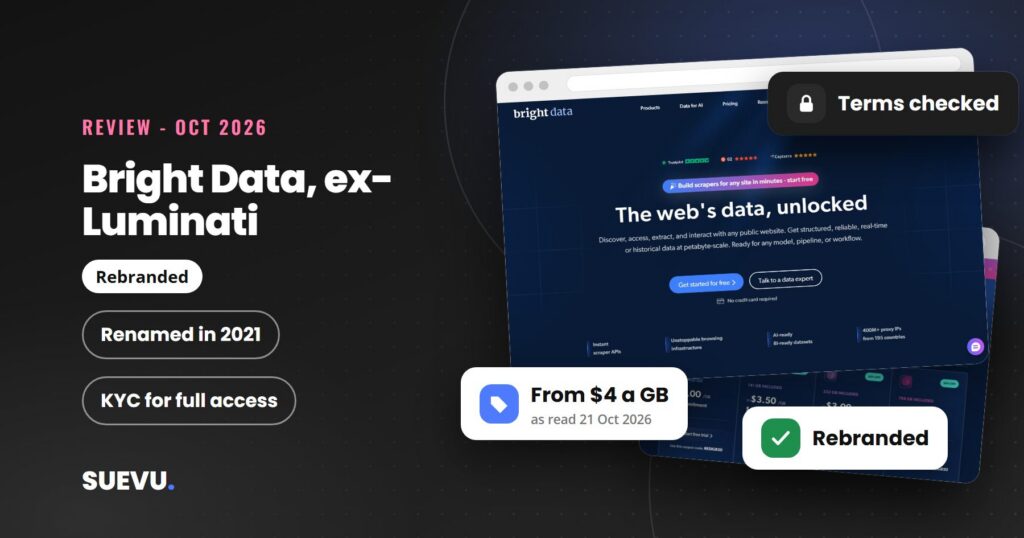
This Bright Data review covers the proxy provider that used to trade as Luminati, which is why this page still lives at the old Luminati address. Bright Data sells residential, mobile, ISP and datacenter proxies, mostly to companies that collect web data. This page sets out what its own pages say as of 21 October 2026, what independent sources report, and what it means if you want to use proxies with Instagram automation.
We do desk research only. We did not sign up for, pay for or run Bright Data, so everything below comes from Bright Data’s public pages and from the independent sources named in the text, all read on 21 October 2026.
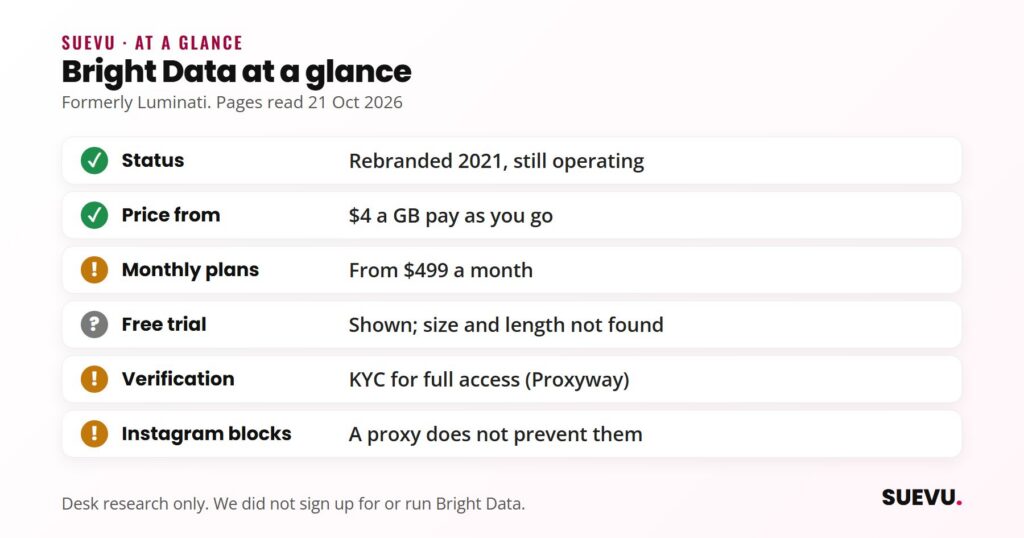
Quick answer: Bright Data is the 2021 rename of Luminati Networks and is still operating. It is a large, business-focused proxy provider with a pay-as-you-go option, monthly commitments from $499 and a free trial. A proxy only hides your IP address: it does not make automation that breaks Instagram’s rules safe.
Status: rebranded (Luminati is now Bright Data). Price from: $4 a GB pay as you go for residential proxies, as listed on 21 October 2026. Safety: proxies do not protect an account from action blocks.
What Bright Data is
Bright Data is the company formerly known as Luminati Networks. According to Wikipedia, it began in 2014 as a division of the Hola VPN company, was sold separately to the investment fund EMK Capital in 2017 and was renamed Bright Data in March 2021. Wikipedia tags the exact rename date as needing a citation, and Proxyway’s review describes the same change as happening in early 2021. Bright Data’s own pricing pages do not mention Luminati, so the link between the two names rests on those independent sources.
The company is listed as headquartered in Tel Aviv, Israel. It sits in our Proxies category, which also includes our Oculus Proxies review. Our earlier review under the Luminati name dates from 2021. Its plans, network figures and prices are out of date, and this page replaces it.
A proxy is an intermediary server that passes your requests on to a website, so the site sees the proxy’s address instead of yours (Wikipedia’s definition). People use them for data collection, price checks, ad verification and testing how a site looks from another country. None of that is specific to Instagram. For a proxy provider that appears to have shut down, see our Leaf Proxies status page.
How it works
You create an account, choose a proxy type and receive a gateway address and credentials. Your software sends its traffic through that gateway, and Bright Data routes each request through an IP from its pool. You can choose a country and, on residential proxies, a state, city or zip code, according to the pricing page.
Residential proxies use IP addresses assigned to ordinary households. Mobile proxies use addresses from mobile carriers. Datacenter proxies use addresses from servers in data centres, which are cheaper and faster but easier for websites to recognise. Bright Data also provides a free Proxy Manager tool, which the pricing page lists with its top tier.
Access is not entirely self-service. Proxyway reports that full access requires identity verification (KYC): a payment authorisation, personal details and a wait of up to three business days, with a video call for freelancers. It adds that scraping behind logins is prohibited and that a limited no-verification mode covers more than 200 websites. We have not confirmed which sites are in that list, and we could not confirm how Bright Data treats Instagram specifically.
Features
Residential proxies
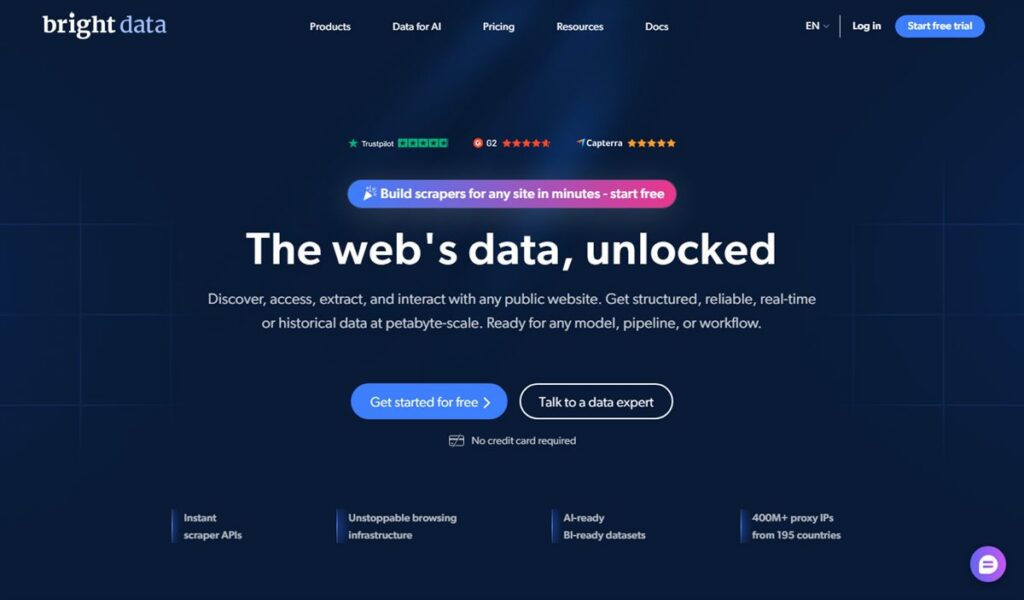
- “400M+ rotating residential IPs in 195 countries”, according to the pricing page. This is Bright Data’s own figure.
- Country, state, city and zip code targeting.
- Dedicated residential IPs in 195 countries, per the pricing FAQ.
Mobile proxies
- “7M+ Mobile IPs”, per the pricing page.
- The page gives no mobile-specific country count, so we cannot say how many countries mobile covers.
Datacenter and ISP proxies
- Shared datacenter IPs by the GB or by the IP, and dedicated IPs.
- Proxyway lists the advertised pools as 1.3 million each for datacenter and ISP.
Tools and service
- Free Proxy Manager, a 99.99% network uptime claim and a premium SLA on the largest tier.
- Proxyway rates its documentation and support as solid, though support quality depends on the plan.
Proxyway’s review scored Bright Data 9.3 out of 10. Its March 2024 tests found success rates around 99% across locations on its general test targets. Pool figures are what a vendor advertises: in its own sampling Proxyway counted about 885,000 unique residential IPs, far fewer than the advertised 400 million, though the two numbers measure different things.
Bright Data pricing (read on 21 October 2026)
Bright Data’s pages show discounted prices with a promo code for three months, with the original prices struck through. We list the prices shown on the day. Treat them as moving: promotions change, and the per-GB figures on two pages did not match exactly.
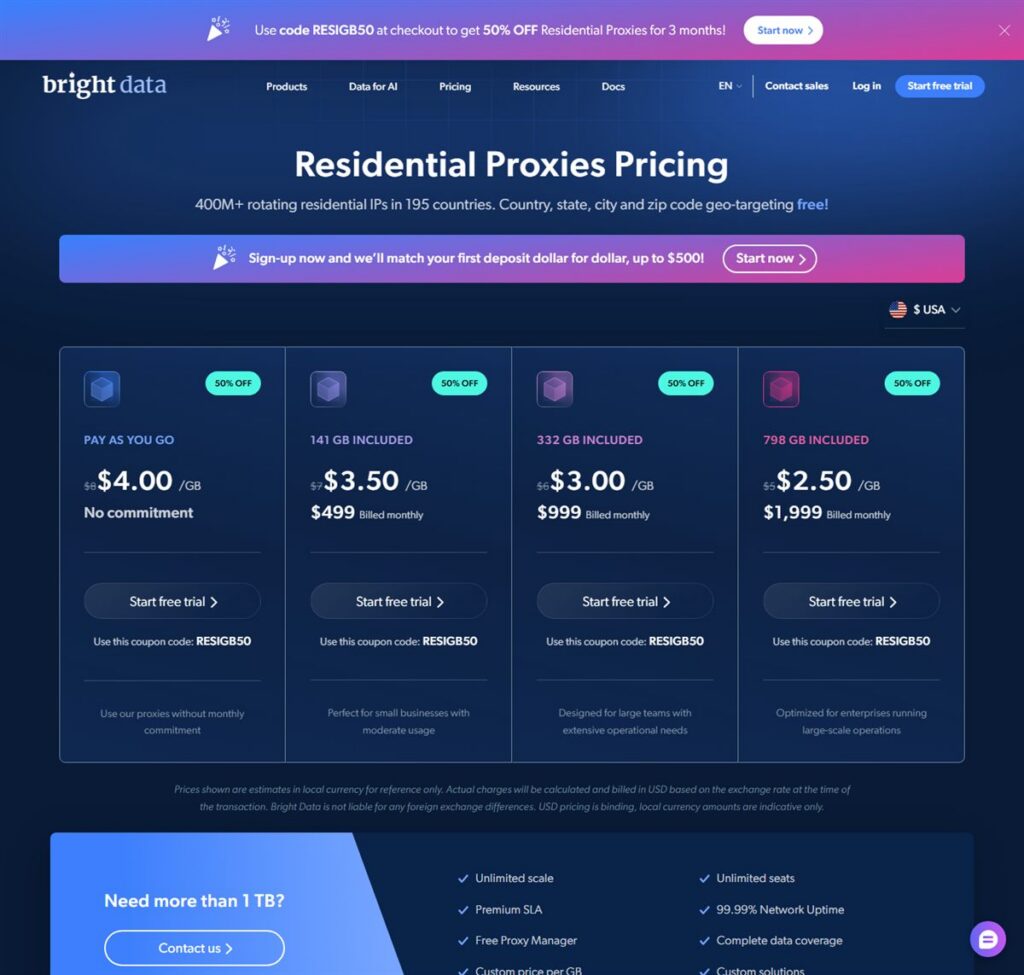
| Residential plan | Monthly commitment | Included GB | Price a GB as shown |
|---|---|---|---|
| Pay as you go | None | Not listed | $4 (struck-through $8) |
| Small business | $499 | 141 | $4 (struck-through $7) |
| Large teams | $999 | 332 | $3 (struck-through $6) |
| Enterprise-scale | $1,999 | 798 | $3 (struck-through $5) |
| Over 1 TB | Custom | Custom | Contact sales |
Dividing each monthly commitment by its included GB gives roughly $3.54, $3.01 and $2.50 a GB. The mobile pricing page shows $3.50, $3 and $2.50 for the same three tiers, so the rounded $4 and $3 figures on the residential page are approximate. The pay-as-you-go FAQ on the mobile page says that plan covers datacenter, residential, ISP and mobile proxies.
- Datacenter: pay as you go at $0.60 a GB, or $0.51, $0.45 and $0.42 a GB on the $499, $999 and $1,999 monthly tiers. Shared IPs start at $14 a month for 10 IPs, and dedicated IPs at $22 a month for 10, with a 100 GB fair-usage allowance per IP.
- Free trial: the pricing page shows a free trial on the residential plans and says bandwidth used in a trial appears on your dashboard but is not billed. We could not find the trial’s size or length on the pages we read.
- Refunds and cancellation: we did not read Bright Data’s terms, so we cannot state its refund or cancellation rules.
- Verification: Proxyway reports a $5 payment authorisation and KYC for full access.
Proxyway calls Bright Data’s pricing premium and says it is hard to find a more expensive provider, especially for rotating ISP proxies. Our 2021 review made a similar complaint, but the pay-as-you-go option and the lower per-GB prices are new since then. For comparison, see our Decodo review.
Safety and risks
The main risk for Instagram users is a misunderstanding: a proxy changes the address your traffic comes from, not what your software does. Automated follows, likes and comments still break Instagram’s rules from any IP address. In its November 2018 announcement, Instagram said apps that boost popularity this way violate its Community Guidelines and Terms of Use, that it removes the fake activity, and that accounts which keep using such apps may see their experience affected.
Other risks to weigh:
- Sourcing of residential IPs. Residential proxies run through other people’s connections. Wikipedia reports that Luminati sold access to Hola’s free VPN users as exit nodes, and that Hola changed its FAQ to disclose this after the company was contacted about it. Proxyway reports that Bright Data is strict about vetting customers and removed about 10% of its pool to cut unethical partners, but it also lists controversies including the Hola link. We could not read Bright Data’s own ethics page, so we cannot confirm its consent statements.
- Cost surprises. The monthly commitments from $499 are charged whether or not you use the traffic. The datacenter page says unused commitment does not roll over.
- Weaker results on some targets. Proxyway’s tests found Instagram succeeded about 72.5% of the time, against around 99% on its general infrastructure tests. That measures collecting public pages, not logged-in account use.
- Legal context. Wikipedia reports that Meta sued Bright Data in 2023 over scraping Facebook and Instagram, and that in January 2024 a federal judge ruled Bright Data had not breached Meta’s terms of use. This is not legal advice, and it concerns public data collection, not running accounts.
If you run an Instagram account, using an account-management tool through a proxy does not remove the account risk. For the wider picture, see our guide to Instagram automation.
Pros and cons
Pros
- One of the largest advertised residential networks, with all four proxy types in one account.
- A pay-as-you-go option and a free trial, which the 2021 version of this review did not have.
- A free Proxy Manager and detailed management tools.
- A 9.3 out of 10 rating from Proxyway, which praises speed, stability, documentation and support.
Cons
- Premium pricing, with monthly commitments from $499.
- Identity verification for full access, which Proxyway calls invasive.
- The platform is technically complex, according to Proxyway.
- Instagram success rates were lower than average in Proxyway’s tests.
- The company’s history with Hola’s exit-node model draws questions about sourcing.
Who it suits
Bright Data suits companies that collect public web data at scale, need many locations and have a budget for it. It does not suit a single Instagram account owner who wants to look “safer” while automating: the price is high, verification is required and a proxy does not change what Instagram sees your software doing. For another provider’s pricing, see our Stormproxies review.
Alternatives
Other proxy providers we have covered include Decodo (formerly Smartproxy), Oxylabs, Stormproxies and GeoSurf. Our 2021 reviews of some of them also need refreshing, so check their pages before you rely on the numbers. If your real goal is more Instagram followers, a proxy is the wrong tool: our roundup of Instagram tools covers options built for the job.
Also see what happened to GeoSurf (closed Dec 2023).
Bright Data FAQ
Is Bright Data the same company as Luminati?
Yes. Wikipedia and Proxyway both report that Luminati Networks was renamed Bright Data in 2021.
Is Bright Data still operating?
Yes. Its pricing pages were live and showing current plans on 21 October 2026.
How much does Bright Data cost?
Residential proxies start at $4 a GB pay as you go as listed on the day, with monthly plans from $499. Datacenter proxies start at $0.60 a GB. Prices and discounts change.
Does Bright Data have a free trial?
The residential pricing page shows a free trial and says trial bandwidth is not billed. We could not confirm its size or length.
Can I use Bright Data proxies for Instagram?
Technically you can route traffic through them, but Proxyway reports Bright Data prohibits scraping behind logins, and Instagram’s rules still apply to anything your software does on an account.
Will a proxy stop Instagram blocking my account?
No. A proxy changes the IP address, not the automated behaviour that triggers action blocks.
Further reading
Pages read on 21 October 2026.