
 Grace Sullivan
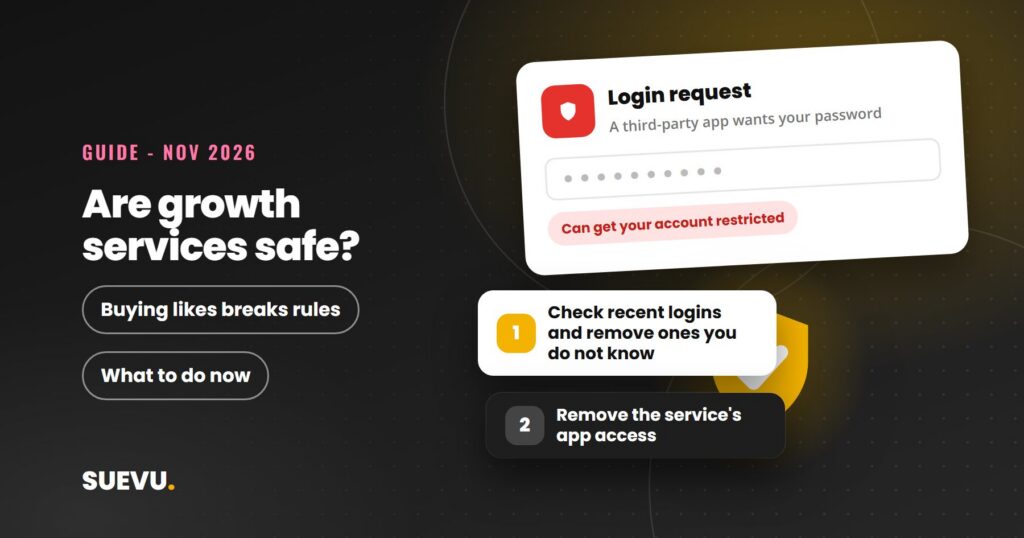
Growth services promise more followers for a monthly fee, and the first question most people ask is whether using one can get their Instagram account banned. Instagram doesn’t publish a list of services it allows or blocks, but its Terms of Use, its spam policy and its help pages say a lot about how these services work and what Instagram does about them. We read those pages on 24 November 2026.
This is desk research: we didn’t sign up for or use any growth service for this guide, and it’s a summary of Instagram’s and the FTC’s own pages, not legal advice.
Quick answer: it depends on how the service works. Instagram’s Terms forbid automated access without its permission, buying or selling engagement and collecting other people’s passwords, and its help pages say giving your password to “apps that offer likes or followers” can get your account restricted. Services that sell likes or followers, or log in with your password to follow and like for you, carry that risk. Tools that connect through Meta’s official login to publish, reply to messages or read insights don’t, but they won’t grow your following on their own. A newer kind of growth service, Kicksta among them, says it needs only your username and takes no actions on your account, which removes the password and action-block risks.
The kinds of growth service
“Growth service” covers businesses that work in very different ways, and the risk follows the method rather than the label.
The first kind sells numbers. You pay for a set amount of followers, likes or views, usually with nothing more than your username, and the engagement arrives from accounts you’ve never met. Our guide to buying Instagram followers covers the sellers we’ve looked at.
The second kind runs your account for you. You hand over your username and password, and the service follows or likes accounts it picks to match your audience, hoping some of them follow you back. Our Instagram growth services comparison has a column showing whether each one’s own pages say it needs your password.
A newer group needs only your username. Kicksta works this way: its FAQ, read on 24 November 2026, says it “never asks for your password, never logs in to your account and runs no automated follows, likes or DMs from it”. You pick the accounts and hashtags your audience already follows, set filters such as age, interests and language, and Kicksta says real followers from that audience then start following you, with bot and spam filtering on top. (Its terms note that some older plans on its legacy dashboard may still use a password.) Because nothing is done from your account, the password and action-block risks described below don’t apply to it, and its FAQ says the same about action blocks. Its pages don’t explain how those people are reached, so that’s a fair question to put to any username-only service before you sign up.
The last kind connects through Meta’s official login. Many schedulers, analytics tools and DM tools work this way, the DM tool ManyChat among them. They don’t ask for your password, but they also don’t follow or like accounts for you, so they aren’t growth services in the usual sense.
What Instagram’s rules say
Three of Instagram’s own documents apply.
The Terms of Use say you can’t access or collect information “in an automated way without our express permission”. They also say you can’t buy or sell any account or data obtained from Instagram, and that includes trying to “solicit, collect, or use login credentials” of other users or to “request or collect Instagram usernames, passwords”. Read plainly, that covers a service that collects its customers’ Instagram passwords.
Meta’s spam policy, which covers Instagram, says it doesn’t allow “selling, buying, or exchanging for engagement, such as likes, shares, views, follows”. It also lists posting, engaging or creating accounts “either manually or automatically, at very high frequencies” as spam, and says accounts acting more slowly can be restricted too when other signs of inauthentic activity are present. Doing it by hand doesn’t change the rule.
Instagram’s Recommendations Guidelines name accounts that “repeatedly engaged in misleading practices to build followings, such as purchasing ‘likes'” among those it tries not to recommend. We explain what that means for reach in our guide to what Instagram says about shadowbans.
Can a growth service get you banned?
Instagram’s pages describe several things that can happen, and an outright ban is the far end of them.
In a November 2018 announcement, Instagram said it had started removing “inauthentic likes, follows and comments from accounts that use third-party apps to boost their popularity”, using machine learning to find those accounts. Accounts it found were sent an in-app message and asked to change their password, and it warned that accounts which kept using such apps “may see their Instagram experience impacted”.
Its help page on data scraping says an account can be “restricted and flagged for further review” when Instagram detects unauthorized automated activity. One of the reasons it lists is that you may have “provided your username and password to a third-party app or website (like apps that offer likes or followers on Instagram)”.
Beyond that, the Terms say Instagram can remove content and disable or terminate an account that breaks the Terms or its policies. Account Status, in Settings, shows features you can no longer use and lets you appeal. Instagram doesn’t publish the thresholds that trigger any of this, so no service can promise that its method is ban-proof, whatever it says on its homepage.
Should you give a service your password?
Instagram’s own pages make a strong case against it. Its Terms forbid collecting other users’ passwords, the scraping help page names password sharing with like and follower apps as a cause of restrictions, and the 2018 announcement said accounts that share their login “are sometimes used by third-party apps for inauthentic likes, follows and comments”, which “makes these accounts less secure”.
There’s also the ordinary security question. Anyone who holds your password can do anything you can, and you’re trusting a company you probably can’t name to store it safely. If your password is the same one you use elsewhere, the risk spreads beyond Instagram. Our guide on what to do if your account is hacked covers the worst case.
The official alternative is Meta’s own login. Meta’s developer overview says apps can connect Instagram professional accounts through an Instagram or Facebook login, and lists what they can do: “have conversations with end users, moderate comments, send private replies, publish content, publish ads, and get insights”. Following or liking other accounts isn’t on that list, which is why a service that grows you by following and liking has to work another way. Our page on what Instagram allows for automation sorts tools by this difference.
Buying followers and US law
In the US, the Federal Trade Commission’s rule on fake reviews, announced in August 2024, also covers social media. The FTC says it “prohibits anyone from selling or buying fake indicators of social media influence, such as followers or views generated by a bot or hijacked account”. The press release limits this to cases where the buyer “knew or should have known” the numbers were fake and used them to misrepresent their influence “for a commercial purpose”, and says the FTC can seek civil penalties against knowing violators.
For a business or creator selling sponsorships, that turns a platform rule into a legal risk. Rules differ by country, so check the ones that apply to you.
How to check a service before you pay
Before you pay anything, read the service’s own pages for answers to a few questions.
- Does it ask for your Instagram password, or does it connect through a sign-in page on instagram.com or facebook.com?
- Does it sell a fixed number of followers or likes? Bought numbers are what Instagram’s spam policy and the FTC rule describe.
- Does it say who runs it, with a company name and address in its terms?
- Can you cancel online, and does it say when refunds apply?
- Does it promise results it can’t control, such as a guaranteed number of real followers or no risk to your account?
Our reviews of individual services report what their own pages say on these points, and the best Instagram followers apps roundup puts them side by side.
If you’ve already used one
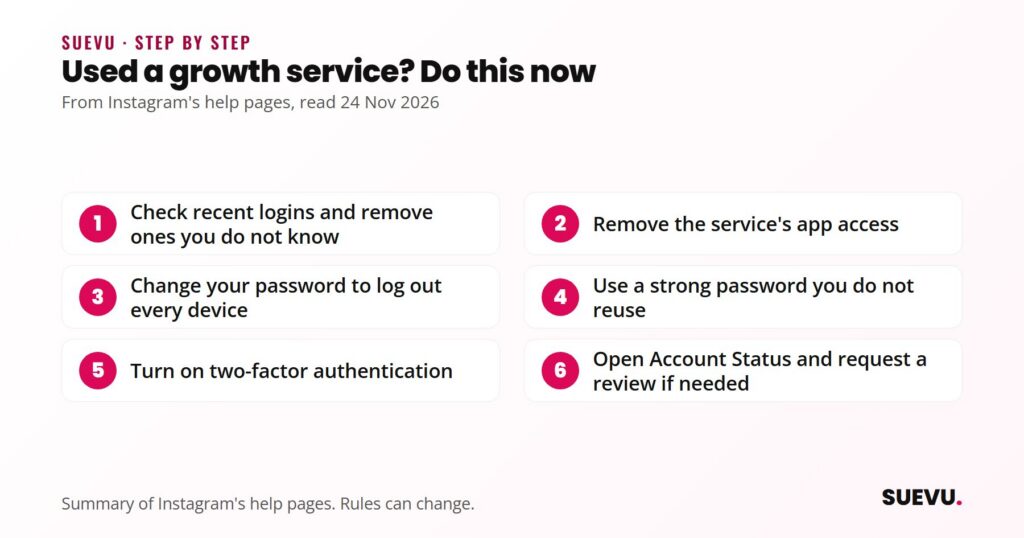
Instagram’s help page on scraping lists the first five steps, and its Account Status page covers the last. They apply to any service you’ve shared your login with.
- Check your recent login activity and remove any logins you don’t recognize.
- Remove the service’s access to your account if it connected as an app.
- Change your password. Instagram says this logs you out of every device, including the service’s.
- Pick a strong password, and don’t reuse it anywhere else.
- Turn on two-factor authentication.
- Open Account Status in Settings to see whether any features are limited, and request a review if a decision looks wrong.
After that, growth comes back to the slower work: posting regularly, replying to comments and making things people share. Our guide to building an Instagram following walks through it.
Instagram growth services FAQ
Are Instagram growth services legal?
Instagram’s rules and the law are separate questions. Buying likes or followers breaks Instagram’s Terms and spam policy. In the US, the FTC rule bans buying or selling fake followers or views when the buyer knew or should have known they were fake and uses them for a commercial purpose.
Can Instagram tell if I use a growth service?
Instagram says it uses machine learning to find accounts that use third-party apps to boost their popularity, and it has teams that detect and block scraping. It doesn’t say how accurate those systems are.
Is a growth service that doesn’t need my password safe?
It removes the password risk, and services such as Kicksta that also say they take no actions on your account remove the action-block risk too. What’s left is how the followers arrive: if a service delivers bought likes or follows, that still breaks Instagram’s spam policy. Tools that use Meta’s official login to publish, reply or read insights are the ones built to work within Instagram’s rules.
What happens if Instagram catches me?
The documented steps range from removing inauthentic likes and follows, through not recommending your account to non-followers and restricting features, to disabling the account. Account Status shows what applies to you.
How do I stop a growth service from accessing my account?
Change your password, which logs out every device, remove any logins and apps you don’t recognize, and turn on two-factor authentication. Cancel the subscription on the service’s own site too, so you aren’t billed again.