
 Erica
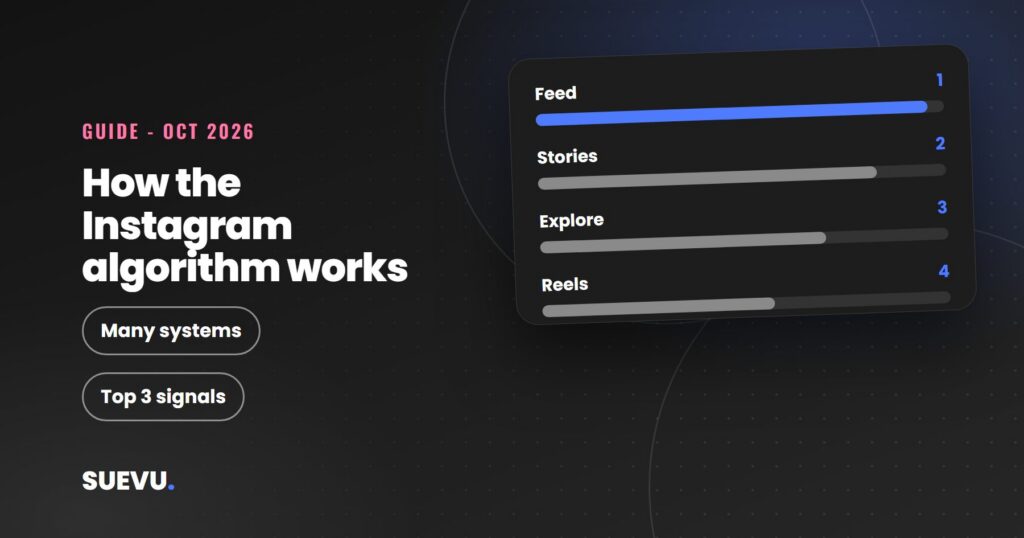
The Instagram algorithm is not one algorithm. Instagram says it uses several ranking systems, one for each part of the app, and that each system looks at signals such as your activity, the post itself and your history with the person who posted it. This guide explains what Instagram has said publicly, read on 21 October 2026, and what that means for the way you post.
Most advice on this topic is folklore. We stick to what Instagram and its head, Adam Mosseri, have published, and we flag anything that comes from third parties or that Instagram has not confirmed. Our Instagram tips hub collects related practical guides.
Quick answer: Feed, Stories, Explore and Reels each rank content differently. In January 2025 Mosseri named watch time, likes and sends as the top three ranking signals. To work with the system, make content people watch to the end, like and send to friends, post original work, and stay within Instagram’s recommendation rules.
Status: current as of 21 October 2026; Instagram’s most detailed ranking explainer is dated 31 May 2023. Cost: free. Risk: tools that automate likes, follows or comments break Instagram’s terms.
What the Instagram algorithm is
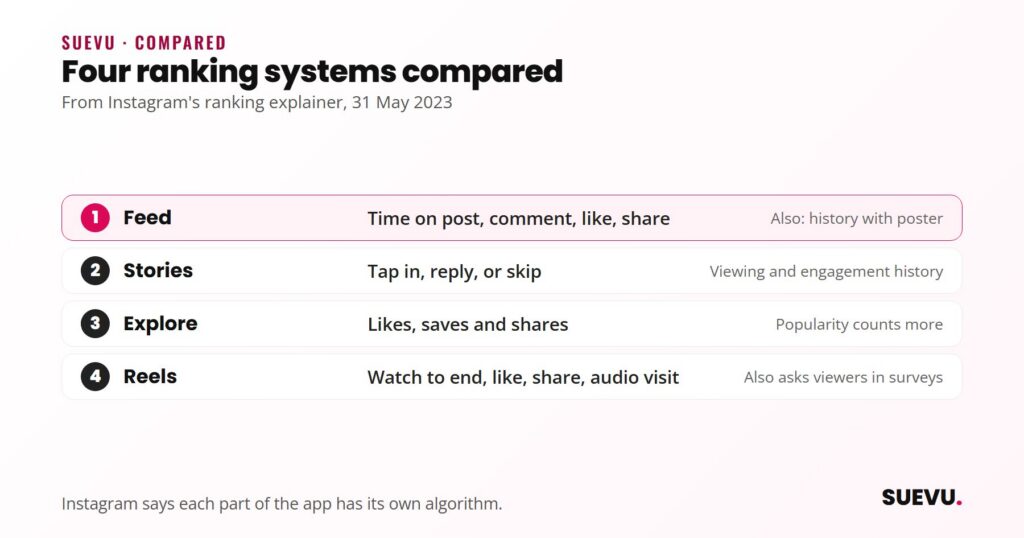
When people say “the algorithm”, they mean the automated systems that decide which posts, Stories and Reels each person sees, and in what order. Instagram’s own explainer says the app does not have a single algorithm: “Each part of the app… uses its own algorithm tailored to how people use it.” Its reasoning is that people use Stories to keep up with close friends, Explore to find new things and Reels to be entertained.
Two things follow. There is no one trick that lifts everything, and what works for a Reel may not matter for a Story. The rest of this guide takes each surface in turn, using Instagram’s own ranking explainer by Adam Mosseri (31 May 2023) as the base.
How ranking works in each part of the app
In every case Instagram predicts how likely you are to take certain actions and ranks higher the content you are most likely to value. The signals below are listed in Instagram’s own order of rough importance.
Feed
- Signals: your activity (likes, shares, saves, comments); information about the post, including how popular it is and how quickly people engage; information about the poster; and your history of interacting with that person.
- What it predicts: how likely you are to spend a few seconds on a post, comment, like, share, or tap the poster’s profile photo.
- Other rule: Instagram says it tries not to show too many posts from the same person, or too many suggested posts, back to back.
Stories
- Signals: your viewing history, your engagement history (such as likes or messages) and how close you are to the person who posted.
- What it predicts: how likely you are to tap into a Story, reply to it, or skip to the next one.
Explore
- Signals: information about the post, your activity in Explore, your history with the poster, and information about the poster.
- What it predicts: likes, saves and shares. Instagram says post popularity matters much more in Explore than in Feed or Stories.
Reels
- Signals: your activity, your history with the poster, information about the Reel (such as audio, visuals and popularity) and information about the poster, including follower count and engagement.
- What it predicts: whether you will watch the Reel all the way through, like it, share it, or visit its audio page.
- Surveys: Instagram says it also asks people whether a Reel was worth their time or fun.
For a practical look at the discovery side, see our guide to getting on the Instagram Explore page.
The top three signals Mosseri named
Social Media Today reported on 22 January 2025 that Mosseri, in the first video of a series on how Instagram’s systems work, said: “The top three signals that matter most for ranking are watch time, likes and sends.” He advised creators to watch average watch time, likes per reach and sends per reach in their insights.
He also split the picture by audience. Likes are “slightly more important for connected content” (people who follow you), and sends are “slightly more important for unconnected content” (people who do not). A send is when someone shares your post with a friend in a message.
Comments were not on his list. Some third-party sites put exact multipliers on these signals, such as sends counting several times more than likes. Instagram has not published such figures, so we do not use them.
Original content and reposts
Instagram has said it wants to favour original work. TechCrunch reported on 20 April 2022 that Mosseri announced a ranking change to “value original content more, particularly compared to reposted content”. Instagram said it builds classifiers to estimate how likely a piece of content is to be original, and that it would be less likely to recommend accounts that mainly aggregate other people’s content.
Instagram’s creator guidance repeats the point. It tells creators to post content they filmed themselves or that has not been on Instagram before, to avoid re-uploading Reels already on the app, and to avoid visibly recycled content such as watermarks or blurry video. Its recommendations page also lists “unoriginal content that is largely repurposed from another source with only minor, immaterial edits” among content it tries not to recommend.
Recommendation rules and Account Status
Recommendations are content from accounts a person does not follow. Instagram’s recommendations page says its Recommendations Guidelines set a higher standard than the Community Standards for this reason. Content that breaks them can still reach your followers, but Instagram tries not to recommend it to others.
Among the things it says it tries not to recommend are unoriginal repurposed content, long captions unrelated to the content, and coordinated comment networks intended to artificially drive engagement. For accounts, it lists those that recently broke the Community Guidelines or repeatedly used misleading practices to build followings, such as buying likes.
According to Instagram’s creators page (last updated 25 April 2023), professional accounts can check eligibility in Account Status. Open Settings, then Account, then Account Status. It shows whether your content can be recommended, and sample posts or profile elements that may break the guidelines. Instagram’s help page says the exact menu route differs by device, so check your app. Instagram also states that only public accounts are recommended.
How to work with the algorithm: step by step
- Make your account eligible. Keep it public, follow the Community Standards, and open Account Status if you have a professional account.
- Post original work. Film or design it yourself. If you share someone else’s Reel, Instagram suggests sharing it to your Story instead of re-uploading it.
- Design for watch time. Hook viewers early. Instagram’s creator guidance says to grab attention in the first 3 seconds and keep Reels short, and notes that content must be 3 minutes or less to be recommended.
- Make it worth sharing. Ask yourself if someone would send it to a friend. Sends are one of the three signals Mosseri named.
- Use a vertical format. Instagram says it tries to avoid recommending Reels that are low-resolution, bordered, watermarked or mostly text.
- Write searchable captions. Instagram says search results are matched by text, so put relevant keywords in your profile name, bio and captions, not in comments. See our guides on writing Instagram captions and why hashtags may not work.
- Build real relationships. Feed and Stories both weigh your history with the poster, so replies and conversation matter. Our guide on increasing engagement covers this.
- Read your insights. Compare average watch time, likes per reach and sends per reach across several posts, as Mosseri suggests. One post proves little.
Next, you may want how to connect Facebook to Instagram and how to delete an Instagram account.
Myths and what Instagram says
“Instagram hides your posts”
Instagram says that when it ranks content, it does not intend to limit it without a clear reason. In its 2021 explainer it also says: “We can’t promise you that you’ll consistently reach the same amount of people when you post.” Reach varies from post to post.
“Shadowbanning is real”
Instagram acknowledges that people use the term for content limited “without a clear explanation or justification”. It says that is not its intention, and points to Account Status as the place where you can see if anything makes your content less visible and appeal it. We found no official feature called a shadowban, and third-party “shadowban checkers” cannot see Instagram’s systems.
“Instagram suppresses reach so you buy ads”
Instagram’s explainer says it does not suppress content to encourage people to buy ads. We cannot independently test that claim, so we report it as Instagram’s statement.
Safety and risks
- Automation and growth tools. Instagram said on 19 November 2018 that third-party apps that generate inauthentic likes, follows and comments violate its Community Guidelines and Terms of Use, and that accounts that keep using them may see their experience impacted. Services that like, follow or comment for you, or ask for your Instagram password, can lead to action blocks or a ban. Our guide to Instagram automation explains the risk. We do not recommend them as a way to game ranking.
- Bought engagement. Instagram lists accounts that repeatedly use misleading practices such as buying likes among those it tries not to recommend. Fake engagement does not help ranking and can hurt eligibility.
- Engagement pods. Instagram’s recommendation rules name coordinated comment networks intended to artificially drive engagement as a type of low-quality content.
- Algorithm advice sites. Many make specific numeric claims. Do not act on a number unless it traces back to Instagram.
What you can and cannot control
| You can influence | You cannot control |
|---|---|
| Originality, format and hook of your content | What each person has liked and watched before |
| Whether your account meets Instagram’s rules | Instagram changing the signals or their weights |
| Keywords in your profile and captions | How many people see each post, which varies |
| How you reply to people who engage with you | Whether a person is interested in your topic that day |
Beyond the algorithm
Ranking only sorts content people can already see. Quality, a clear topic and real relationships matter more than any tactic. Our related guides cover more, and our guide to building a following covers growth without paid shortcuts.
Instagram algorithm FAQ
Is there one Instagram algorithm?
No. Instagram says Feed, Stories, Explore and Reels each have their own ranking system built for how people use that part of the app.
What are the most important ranking signals?
In January 2025 Mosseri said the top three are watch time, likes and sends. Instagram’s 2023 explainer lists more signals per surface, such as your history with the poster.
Does Instagram show my posts to all my followers?
Not necessarily. Instagram says it cannot promise the same reach each time, and Feed is ranked per person. We found no official share of followers who see a post.
Does Instagram favour Reels over photos?
We found no official statement of that. Instagram’s creator guidance recommends including Reels to maximise chances of being recommended, and ranks each format by predicted viewer actions.
Rules change often. If something here is out of date, tell us on the contact page, as described in our editorial policy.
Further reading
- Instagram: Instagram Ranking Explained (Adam Mosseri, 31 May 2023)
- Social Media Today: Instagram shares algorithm insights (22 January 2025)
- Instagram Help Center: Recommendations on Instagram
- TechCrunch: Instagram to improve its ranking system to better highlight original content (20 April 2022)