
 Erica
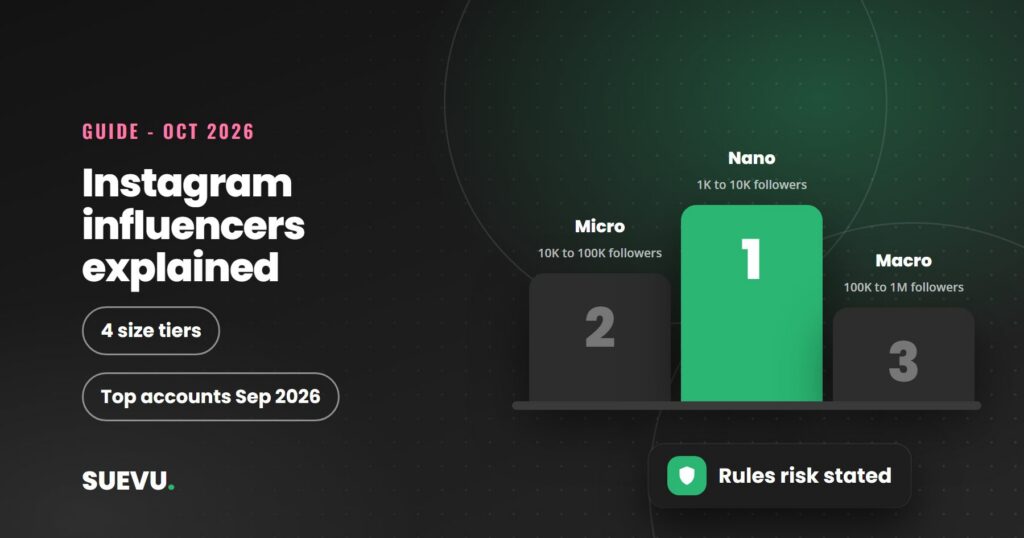
Instagram influencers are people who build an audience on Instagram and use it to recommend products, ideas or places, usually in exchange for payment or free products. This guide explains what Instagram influencers are, the size categories people use, some of the most-followed accounts on the platform, how to become an influencer, and where the rules apply.
It replaces our 2019 article “4 Tools That Can Help You Find Instagram Influencers”, which was written by a former contributor and quoted prices, database sizes and campaign results we could not verify. The tool comparison now lives on a separate page (see below). We do desk research only. Facts here come from pages we opened on 21 October 2026, and follower counts come from a Wikipedia table dated September 2026 and change daily.
Quick answer: an influencer is defined more by audience trust than by follower count. The common size bands are nano (1K to 10K), micro (10K to 100K), macro (100K to 1M) and mega (1M+), but they are a convention, not an official standard. To become one, pick a niche, post consistently, understand the disclosure rules and treat brand deals as something you earn, not something you buy.
Safety: buying followers or using bots to grow can break Instagram’s rules and, for commercial use, now falls under an FTC ban on fake social media indicators.
What an Instagram influencer is
Wikipedia’s entry on influencer marketing describes influencers as people with expert knowledge or social influence in a field who post original content, often sponsored, on platforms such as Instagram, YouTube and TikTok. Instagram itself launched in 2010 and is owned by Meta, according to Wikipedia’s Instagram entry, which says it reached 1 billion monthly active users in June 2018.
Three things usually define an influencer: a focused topic, an audience that engages with the posts, and the habit of recommending things. A person with 3,000 engaged followers in a narrow niche can be worth more to a local brand than a general account with ten times the followers. For the brand view, see our guide to Instagram influencer marketing.
Types of influencers by size
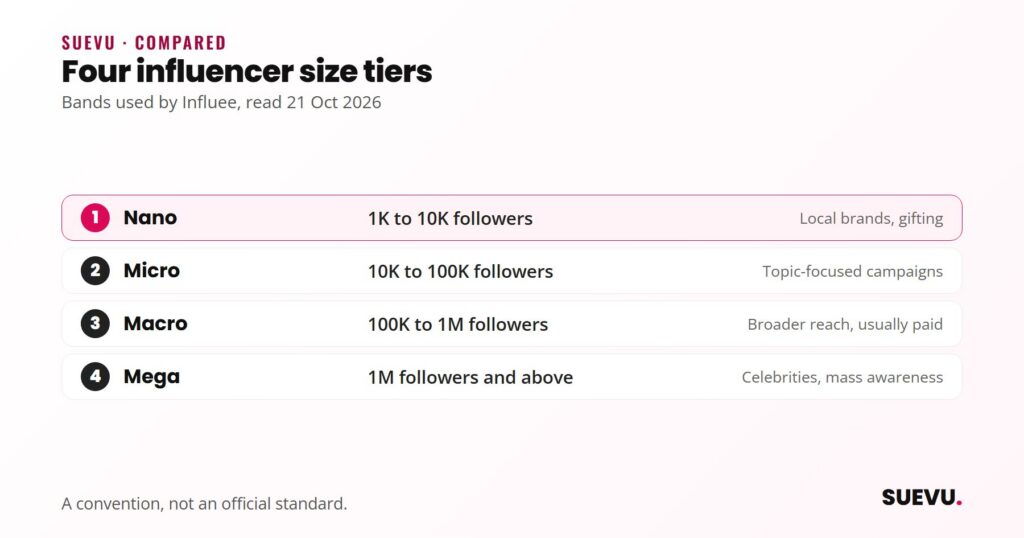
Marketers sort influencers into tiers. The bands below are the ones used by the influencer marketing agency blog Influee, read on 21 October 2026. Wikipedia’s article does not define tiers, and other sources use slightly different cut-offs, so treat them as rules of thumb.
| Tier | Followers | Typical use |
|---|---|---|
| Nano | 1K to 10K | Local brands, gifting, niche communities |
| Micro | 10K to 100K | Topic-focused campaigns with a defined audience |
| Macro | 100K to 1M | Broader reach campaigns, usually paid |
| Mega | 1M and above | Celebrities and mass awareness |
The “typical use” column is our summary of how brands commonly describe each tier, not a measured result. Smaller creators often charge less, but fit and engagement matter more than the label. Our guide to increasing engagement on Instagram shows what drives the numbers brands look at. Reviews of influencer tools sit in the Influencer Platforms category.
Most-followed accounts
The accounts below are the top of Wikipedia’s list of most-followed Instagram accounts, which says its table is “as of September 2026”. Counts are in millions of followers and are rounded as the table gives them.
| Rank | Account | Followers (millions) | Type |
|---|---|---|---|
| 1 | 686 | Platform brand account | |
| 2 | @cristiano (Cristiano Ronaldo) | 679 | Footballer |
| 3 | @leomessi (Lionel Messi) | 517 | Footballer |
| 4 | @selenagomez (Selena Gomez) | 403 | Musician and actress |
| 5 | @therock (Dwayne Johnson) | 381 | Actor and wrestler |
Two lessons. First, the table’s own type column shows most of the top accounts belong to celebrities such as footballers and musicians, so they are not a model for building an audience from zero. Second, brand accounts such as Instagram’s own and Nike’s also sit in the top ranks.
How to become an Instagram influencer
There is no application and no official follower threshold for calling yourself an influencer. Brands decide based on audience and content. The steps below are our editorial summary, and none is a guarantee of income.
- Choose a niche. A narrow topic makes it clear why someone should follow you and which brands fit.
- Set up the profile. Use a clear photo, a bio that says who you help or entertain, and a single link. Our Instagram bio ideas and link in bio guide help.
- Post consistently. Plan content in batches. See how often to post on Instagram and how the algorithm works.
- Grow honestly. Use hashtags, Reels, collaborations and replies. Our guide to building a following without paying has nine methods.
- Track your numbers. Know your audience country, age and top posts so you can show brands. See Instagram analytics tools.
- Pitch brands. Send a short email with your niche, audience data and an idea. Our guide on how to get sponsors on Instagram covers the process.
- Consider verification later. It is not required. See how to get verified on Instagram. Wikipedia says the blue badge marks public figures, celebrities, brands or entities of public interest and that Meta introduced paid verification.
For a longer walkthrough, use our step-by-step guide on how to be an Instagram influencer.
Rules every influencer should know
Once brands start sending products or money, labelling becomes your legal responsibility in the United States. On 21 October 2026 the FTC’s Disclosures 101 for social media influencers said:
- You must disclose any financial, employment, personal or family relationship with a brand, including free or discounted products.
- Put the disclosure with the endorsement, where it is hard to miss. A bio, the end of a post, a “more” link or a pile of hashtags is likely to be missed.
- Use clear words such as “ad” or “sponsored”, and avoid vague shorthand like “sp”, “collab” or “thanks”.
- For Stories, superimpose the disclosure on the image. For video, put it in the video, ideally in audio and on screen.
- Do not talk about a product you have not tried, and do not say a product is great if you thought it was bad.
- Instagram’s branded content tool can help, but the FTC says to add your own clear disclosure too.
Other countries have their own regulators, so check local rules if your audience or brands are abroad.
For brands: where to find influencers
If you are a brand looking for creators, you can search Instagram by hand or use discovery software. Our guide to finding Instagram influencers compares Heepsy, Modash, HypeAuditor and other tools using their own pages, and explains how to vet a shortlist. To run the campaign afterwards, use our overview of influencer marketing platforms and rules.
Safety and risks
- Bought followers. Fake followers do not buy or engage, and brands can check audiences with tools. In August 2024 the FTC announced a rule banning the sale and purchase of fake social media indicators such as bot followers, where the buyer knew or should have known they were fake and uses them commercially.
- Growth bots. Services that ask for your password or automate likes, follows and comments break Instagram’s rules and can lead to action blocks or bans. Our growth services and automation categories explain the risks of each.
- Unpaid “exposure”. Agree payment or product terms in writing before you post.
- Disclosure mistakes. Unlabelled paid posts can lead to FTC action against both you and the brand.
- Scams. Be careful with messages asking you to pay to join a “brand program” or to share your login.
FAQ
How many followers do you need to be an influencer?
There is no official minimum. Marketers’ tiers start around 1,000 followers (nano), but brands care about engagement and fit.
Who has the most followers on Instagram?
As of September 2026, Wikipedia’s table puts Instagram’s own account first at 686 million, and Cristiano Ronaldo second at 679 million. The figures change continuously.
Do influencers have to say they are paid?
In the US, yes. The FTC says any material connection, including free products, must be clearly disclosed.
Is it worth buying followers to get started?
We do not recommend it. Bought followers do not engage, brands can check audiences, and the FTC has banned selling and buying fake social media indicators for commercial use.
Where can brands find influencers?
On Instagram itself or with discovery tools. Our discovery guide compares them.