
 Alizabeth Swain
How to be an Instagram influencer is mostly a question of building a focused audience that trusts you, then learning the rules that apply once brands get involved. There is no application, no official follower threshold and no guaranteed income, so this guide is a practical step-by-step plan rather than a promise.
It is the detailed walkthrough that goes with our overview of Instagram influencers, the size tiers and the most-followed accounts, so we do not repeat the definitions here. We do desk research only: the rules below come from pages we opened on 21 October 2026, and the growth steps are editorial advice, not measured results. The 2019 version of this article contained opinions and claims we could not verify; they have been removed.
Quick answer: pick one niche, set up a clear professional profile, post on a schedule you can keep, talk to your audience, read your Insights, and only then approach brands. When free products or payment start, disclose them clearly in the post itself.
Status: current as of 21 October 2026. Cost: free to start. Risk: buying followers or using bots can break Instagram’s rules and, for commercial use, can fall under US FTC rules on fake followers.
Before you start
Wikipedia’s article on influencer marketing describes influencers as people who can affect others’ buying habits through their posts, which are often sponsored. The key word is affect: brands pay for trust, not for a number on a profile. A small account that a specific group listens to can matter more to a local business than a large, general one.
Decide early what you are aiming for. Some people want paid partnerships, some want to promote their own business or service, and some just want a community around a hobby. The plan below works for all three, but the later steps (media kit, pitching, contracts) only matter if you want brand work.
The 10 steps
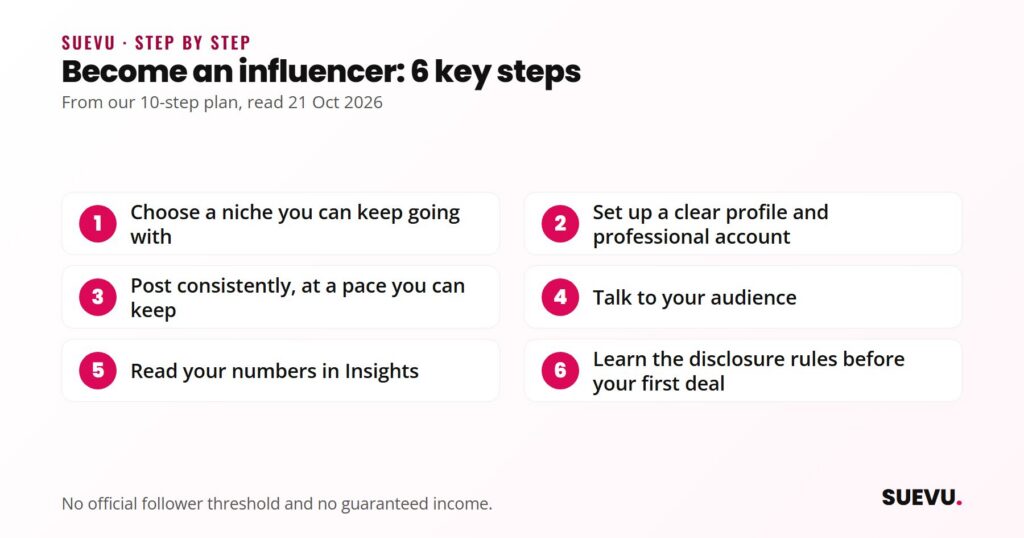
1. Choose a niche you can keep going with
- What it is: a specific topic that explains why someone should follow you, such as home cooking on a budget, trail running or secondhand fashion.
- Why it matters: a clear topic tells followers what to expect and tells brands whether you fit them.
- How to choose: pick something you enjoy enough to post about for a year, and that you already know something about. Combining two related topics (for example food and travel) is fine; random mixes make a profile hard to understand.
2. Know who you are making content for
Write one sentence describing your ideal follower: who they are, what they want and what interest or problem you serve. Every later decision (formats, captions, brands you approach) gets easier with that sentence in front of you.
3. Set up the profile
Use a clear profile photo, a username that is easy to say and spell (see our guide to choosing an Instagram username), and a bio that says what you post and for whom. Add one link and a contact email if you want brands to reach you. Our Instagram bio ideas and link in bio guide cover the details. Switching to a professional account in Settings gives you access to Insights, which you will need in step 8. According to Wikipedia’s Instagram article, Instagram introduced business profiles with analytics in May 2016. Menu names change, so follow the labels in your own app.
4. Build a simple content system
- Pick two or three repeatable formats (for example a short video, a carousel and a Story) so you are not inventing something new every day.
- Batch the work: shoot or write several posts in one session. Our guide to scheduling Instagram posts shows how to plan ahead.
- Make each post clear: see our tips on taking better Instagram photos and writing captions.
5. Post consistently
There is no magic number. Choose a frequency you can sustain for months; see how often to post on Instagram and how the Instagram algorithm treats content. A modest schedule you keep beats a heavy one you drop after a month.
6. Talk to your audience
Answer comments and messages, ask questions in Stories and reply to people who engage. Our guide on increasing engagement on Instagram lists practical ways. Brands look at whether followers actually respond, and a real conversation is also what keeps people following.
7. Reach new people honestly
Use relevant hashtags (how to find trending hashtags, and what to do if hashtags stop working), collaborate with creators in neighbouring niches and aim for posts people want to share or save. Our guide to building a following without paying and the one on getting onto the Explore page go deeper.
8. Read your numbers
Wikipedia’s Instagram article says Instagram’s Insights page, introduced in 2016, shows top posts, reach, impressions, engagement and demographic data. Check which posts do best, where your audience lives and when they are active, and note it down monthly. This is the evidence you will use in a media kit. For third-party options, see our list of Instagram analytics tools.
9. Prepare for brand work
When your content is steady and your audience data is clear, you can start working with brands. Our step-by-step guide to getting sponsors on Instagram covers the media kit, outreach and contracts. Start with brands you genuinely use and understand, since you will need to speak honestly about them.
10. Learn the disclosure rules before your first deal
The rules take minutes to read and prevent mistakes that are hard to undo. They are covered in the next section.
Disclosure rules once brands appear
In the United States, the FTC’s Disclosures 101 for social media influencers (read on 21 October 2026) says:
- Disclose any financial, employment, personal or family relationship with a brand. Free or discounted products count, not just payment.
- Put the disclosure with the endorsement itself. Do not rely on your bio, the end of a post, text behind a “more” link or a pile of hashtags.
- Use simple, clear wording such as “ad”, “advertisement” or “sponsored”. Avoid vague terms like “sp”, “collab” or a stand-alone “thanks”.
- On photos and Stories, put the disclosure on the image and leave enough time to read it. In video, include it in the video itself. In live streams, repeat it.
- Do not describe experiences with products you have not tried, and do not call a product great if you thought it was bad.
- Do not assume a platform’s disclosure tool is enough on its own.
The FTC’s Endorsement Guides questions and answers adds that the FTC Act applies across the board and sets no follower threshold. If you are outside the US, your own country’s regulator has similar rules; check them.
Shortcuts to avoid
Buying followers, bot-run engagement groups and services that ask for your Instagram password can break Instagram’s terms and may lead to limited reach or restricted accounts. They also do not produce the thing brands pay for, which is real attention. Our Like4Like review looks at one like exchange.
There is a legal angle too. The FTC’s questions and answers on its consumer reviews and testimonials rule, which says it went into effect on 21 October 2024, covers buying fake indicators of social media influence, such as followers generated by bots. It applies when the buyer knew or should have known they were fake and used them to misrepresent their influence for a commercial purpose. To see what is out there and what each offer asks for, read our comparison of free follower offers, and browse our growth services reviews before spending money.
What to expect
We do not give timelines or earnings, because we found no reliable source that supports a general figure and results vary widely by niche, effort and luck. A healthier way to track progress is to set small goals you control: posts per week, replies sent, new collaborations, and the share of your audience that matches your niche.
For more articles on the craft of growing an account, browse our Instagram guides.
Related guides: free follower ideas for students.
FAQ
How many followers do I need to be an Instagram influencer?
There is no official number. Brands decide on fit, engagement and audience. Marketers use informal tiers; see our overview of Instagram influencers.
Do I need a professional account?
It is not required to post, but it gives you Insights and contact options, which help when you work with brands.
Do I have to disclose free products?
According to the FTC’s Disclosures 101 page, yes: free or discounted products count as a relationship that should be disclosed.
Is it okay to buy followers to look bigger?
We advise against it. It can break Instagram’s rules, it adds no real audience, and for commercial use the FTC has a rule on fake indicators of influence.
Can I become an influencer without showing my face?
Yes, there is no requirement to appear on camera. What matters is a clear topic and content people want to follow.
How do I get paid?
Through brand deals, your own products or services, and programmes such as affiliate tools. See how to get sponsors. Wikipedia’s Instagram article says Instagram added a native affiliate tool in June 2021, so check what is available in your region.
Further reading
- FTC: Disclosures 101 for social media influencers
- FTC: Endorsement Guides, what people are asking
- FTC: Consumer reviews and testimonials rule, questions and answers
- Wikipedia: Instagram
Last reviewed 21 October 2026.