
 Erica
Instagram influencer marketing means paying or gifting creators to promote your product to their audience, and in 2026 it runs on a mix of free Instagram tools and paid software. This guide explains how Instagram influencer marketing works step by step, what the US disclosure rules require, and how the main campaign platforms compare.
It replaces our 2019 “Top 5 platforms” list, which was written by a former contributor and relied on numbers that are now out of date. We do desk research only: we did not sign up for, pay for or run any platform below. Everything is taken from each provider’s own public pages, read on 21 October 2026, plus the independent sources linked in the text. Plans and prices change, so check before you buy.
Quick answer: pick a goal and a budget first, then choose creators whose audience matches yours, put the terms in writing and make sure every sponsored post is clearly labelled. Software helps once you work with more than a handful of creators. Small teams can start with a free plan or a low-priced tool, and large programs usually need a quote.
Status of the 2019 list: Heepsy, Aspire, Upfluence, HypeAuditor and MightyScout are all still online. Socialbakers is now Emplifi. Prices from the old article are no longer valid.
Safety: brands carry legal responsibility for what creators post for them. Never give any tool your Instagram password.
What Instagram influencer marketing is
Wikipedia describes influencer marketing as a form of social media marketing that uses endorsements and product placement from people with expert knowledge or social influence in a field. On Instagram that usually means a creator posts a Reel, Story or feed post about your product, tagged to your account.
The format works through trust: followers see a person they follow recommending something, not a brand advertising itself. That is also why it carries risk. If the audience is not real, or the post is not labelled as an ad, the campaign can waste money or create legal exposure.
Money is moving into the channel. In its 2026 benchmark report (published 4 May 2026, based on a survey of more than 600 respondents), Influencer Marketing Hub says 87.49% of respondents expect their influencer budget to increase in 2026. It is a trade publisher’s survey, not a census, so read it as a mood indicator. The same report says TikTok’s selection rate among respondents (31%) is more than double Instagram’s, so Instagram is one channel in the mix, not the only one.
This page is the overview. For the people side, see our guide to Instagram influencers, their types and how to become one. For search methods and software, see how to find Instagram influencers.
How a campaign works, step by step
- Set one objective. Awareness, traffic, sales or content for your own channels each lead to different creators and different measures.
- Set a budget and an offer. Decide whether you will pay, send free product or pay a commission. Free product still counts as a paid relationship for disclosure purposes (see below).
- Find and vet creators. Look at audience location, content fit and how engaged the audience really is. Our guide to finding Instagram influencers covers checks and tools.
- Agree terms in writing. Deliverables, dates, usage rights, payment, approval of drafts and how the post will be labelled.
- Approve before posting. The FTC says pre-approving paid posts is easier than searching afterwards, especially for Stories that disappear.
- Measure. Use unique links or codes and Instagram’s own insights. Our analytics tools category and Instagram analytics roundup cover the measuring side.
- Keep the relationship. Creators who liked working with you tend to be easier to rebook. Our piece on how creators get sponsors shows the other side of the deal.
Campaign content also needs an audience that can find it. Ways to increase engagement on Instagram and our Best Of roundups help with the brand account itself.
Disclosure rules for sponsored posts
In the United States the Federal Trade Commission treats creator posts as endorsements. Read on 21 October 2026, its Disclosures 101 for social media influencers says:
- A “material connection” covers money, free or discounted products, and personal, family or employment ties. It must be disclosed.
- The disclosure must sit with the endorsement and be hard to miss. Disclosures in a bio, at the end of a post, behind a “more” link or among hashtags are likely to be missed.
- Use plain wording such as “ad”, “sponsored” or a statement that the brand gave you the product. Vague shorthand like “sp”, “collab” or “thanks” is discouraged.
- In Stories, superimpose the disclosure over the image and leave enough time to read it. In video, include it in the video itself, ideally in audio and on screen.
- Platform tools help, but the FTC says to add your own clear disclosure too. It also says the responsibility is the influencer’s, not the platform’s.
The brand is responsible as well. The FTC’s endorsement guides Q&A says advertisers should have a reasonable program to train and monitor their influencers, and that hiring an agency does not remove the brand’s responsibility. It lists “#ad” or “Ad:” at the start of a post as generally effective and calls terms such as “#ambassador” or “#partner” unclear.
These pages describe US rules. Other countries have their own regulators, and Wikipedia notes that authorities in the UK and Australia have issued similar guidance. If you advertise outside the US, check local rules.
Campaign platforms compared
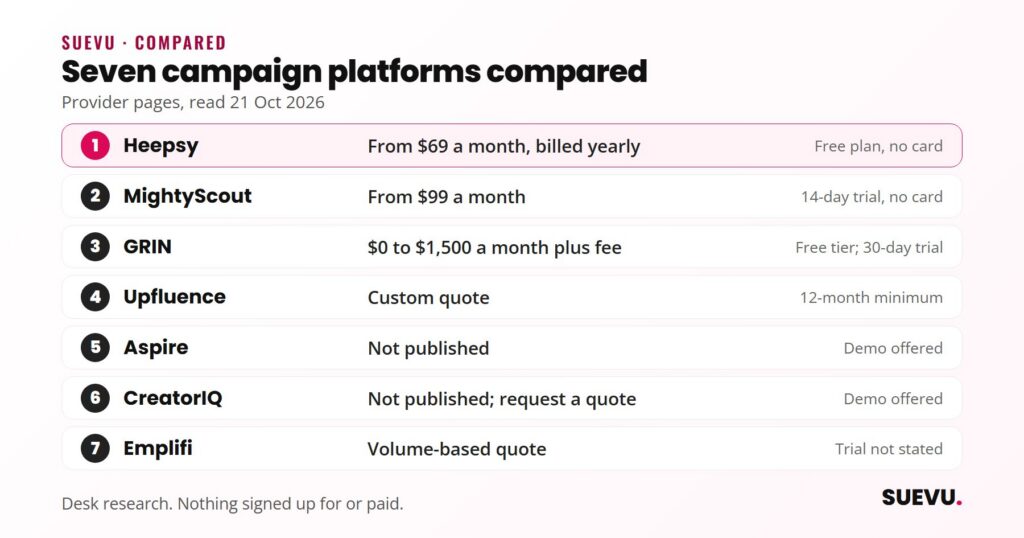
Campaign platforms bundle several jobs: finding creators, outreach, contracts, payments, content tracking and reports. The table shows what each provider’s own page said on 21 October 2026. Counts of creators are the vendors’ own claims and we could not verify them. For platforms whose strength is search and audience data, see our discovery tools comparison.
| Platform | Aimed at | Price (read 21 Oct 2026) | Free plan or trial |
|---|---|---|---|
| Heepsy | Brands and agencies of most sizes | Paid plans from $69 a month billed yearly; $89 billed monthly | Free plan, no card |
| MightyScout | Brands and agencies | From $99 a month, month to month | 14-day trial, no card |
| GRIN | Ecommerce and creator programs | $0 to $1,500 a month plus a fee on wallet deposits | Free tier; 30-day trial on Starter |
| Upfluence | Brands running larger programs | Custom quote; annual contract, 12-month minimum | Trial set up after a call |
| Aspire | Ecommerce brands | Not published on the pages we read | Demo offered |
| CreatorIQ | Enterprises and agencies | Not published; request a quote | Demo offered |
| Emplifi | Large social and customer teams | Volume-based quote | Not stated |
Notes on each platform
Heepsy
- What the page says: a creator database of more than 20 million across Instagram, TikTok, YouTube and LinkedIn, outreach, campaign projects, in-platform payments and content tracking
- Plans: Free ($0, 500 results a month); Starter $69; Plus $149; Advanced $229 (all billed yearly); custom for large teams. Cancel any time
- Limit: the page does not say how its Instagram data is sourced, so audience and fake-follower scores are the vendor’s claims
MightyScout
- What the page says: discovery across TikTok, Instagram and YouTube, a shared inbox, product gifting through Shopify or WooCommerce, and alerts for new posts and Stories mentioning your brand
- Price: from $99 a month with no annual contract and a 14-day trial
- Note: our 2019 list quoted $499 a month. That is no longer what the provider’s page states
GRIN
- What the page says: a creator marketing platform for gifting, affiliate and paid programs, with a creator inbox, deal records and payments held in escrow
- Plans: Free ($0, 20% fee on deposits), Starter $200 (10%), Growth $500 (7%), Scale $1,500 (5%), plus Enterprise by quote
- Limit: the fee on deposits matters for paid campaigns, while gifting-only campaigns need no deposit, per the page
Upfluence
- What the page says: discovery, outreach, payments and tracking, with an AI assistant and a marketplace where creators apply to campaigns. It claims more than 12 million creators
- Pricing: custom, a fixed platform fee, annual plans with a 12-month minimum, per its pricing page
- Limit: no public price, and the page says a call comes first
Aspire
- What the page says: a marketplace and AI creator discovery, campaign manager, contracts, payments, Shopify tie-ins and ad rights tools. It cites 300,000 creators activated and more than 800 brands
- Name: directory listings describe it as the former AspireIQ. Its own homepage does not mention the old name
- Limit: no plans or prices on the page we read, and its pricing address returned an error
CreatorIQ
- What the page says: enterprise software with brand-safety vetting, analytics, creator management and payments; it cites more than 1,300 brands and agencies
- Price: not listed, quote on request
Emplifi (formerly Socialbakers)
- What the page says: a social and customer experience suite with an Influencers module; quotes depend on audience size and volume, not seats
- Rebrand: Wikipedia says Socialbakers was acquired by Astute in 2020 and the combined company rebranded as Emplifi in June 2021
- Limit: the page we read gave no influencer feature detail, so we cannot say how far the module goes
Changes since the 2019 list
- Heepsy: still operating. The 2019 figures (7 million influencers, plans from $49) are replaced by today’s page.
- AspireIQ: now Aspire, still operating.
- Upfluence: still operating. The 2019 claims about customer service were not verified and are dropped.
- HypeAuditor: still operating, covered in our discovery tools comparison. The page we read lists no prices, so the 2019 $299 figure is dropped.
- MightyScout: still operating, with a different price (above).
- Moonio: its address now redirects to Heepsy’s homepage and its status is unclear. See our Moonio status check.
Safety and risks
- Legal. You answer for unlabelled paid posts and for misleading claims creators make for you, even if an agency runs the program (FTC).
- Fake audiences. In August 2024 the FTC announced a rule banning the sale and purchase of fake social media indicators such as bot followers, where the buyer knew or should have known they were fake. Paying for reach from bought followers is a risk for both sides.
- Account safety. Influencer platforms should not need your Instagram password. Services that ask for it, or that automate likes and follows, break Instagram’s rules and can lead to blocks or bans. Connect only through Meta’s official login screen and read what a tool will access first.
- Data claims. Audience quality scores come from each vendor’s own model. Treat them as one input, not proof.
- Contracts. Annual or 12-month terms exist at some vendors. Read cancellation terms before you commit.
How to choose
- One to five creators, tight budget: start with Instagram itself, a spreadsheet and a free plan such as Heepsy’s or GRIN’s.
- Ongoing gifting through an online shop: look at platforms that connect to Shopify, such as MightyScout, GRIN and Aspire.
- Large or global programs: expect to talk to sales at Upfluence, CreatorIQ or Emplifi.
- Not sure who to hire: read our discovery guide first, then return to this table.
Browse more tools in our Influencer Platforms category. If you want a broader map of tool types, see our guide to Instagram tools.
FAQ
Do I need software to run Instagram influencer marketing?
No. A small campaign can run on Instagram searches, email and a spreadsheet. Software saves time once you manage many creators, payments or reports.
Do free products have to be disclosed?
Yes. The FTC says free or discounted products count as a material connection that must be disclosed.
Is “#sponsored” or “#partner” enough?
The FTC prefers clear wording such as “Ad” or “Paid post by” the brand, placed where it is hard to miss. It lists “#partner” and “#ambassador” as unclear.
Can I use Instagram’s own tools instead?
Meta’s developer documentation says its Creator Marketplace, part of Creator Marketing Hub, lets eligible brands search and evaluate Instagram and Facebook creators for partnership ads. Eligibility is checked at onboarding.
Is the cheapest platform the best?
Not necessarily. Compare what the plan includes, such as search results, profile reports, outreach limits and contract length, and not only the monthly price.