
 Grace Sullivan
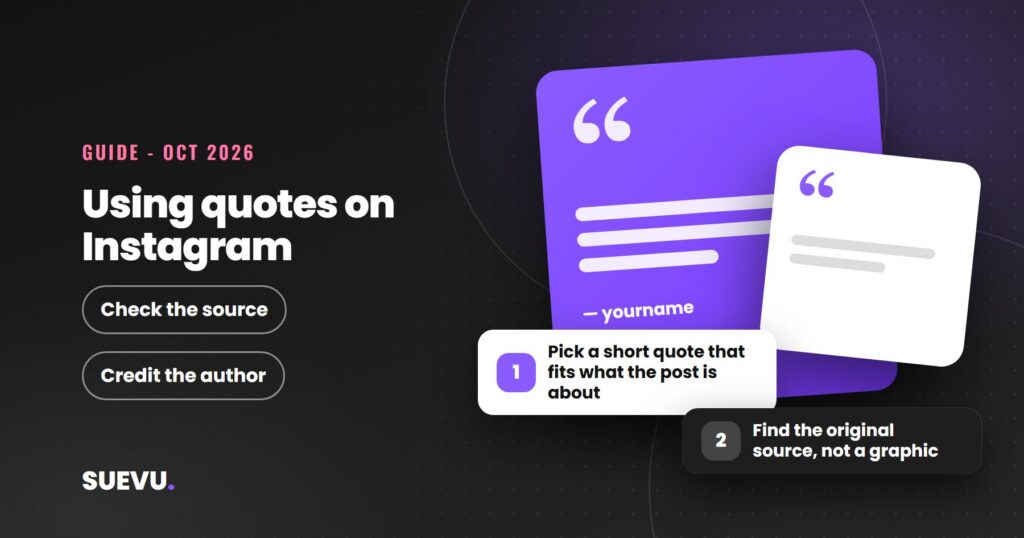
Using Instagram quotes well means choosing a line that fits your post, crediting the right person, staying on the right side of copyright, and formatting it so it is easy to read. This guide covers how to do each of those for captions, images and stories. It does not include a list of quotes: lists of ready-made quotes are often misattributed and can be copyrighted, so we explain how to find and check your own instead. Instagram sources were read on 21 October 2026.
Quick answer: pick a quote that supports what your post is actually about, find the original source rather than a quote site or someone else’s graphic, credit the author in the caption, and use Instagram’s text tools to keep it short and readable. When in doubt about permission, write your own line.
Status: checked on 21 October 2026. Cost: free. Risk: posting someone else’s copyrighted words without permission can lead to removal, and Instagram says repeat infringers can lose accounts.
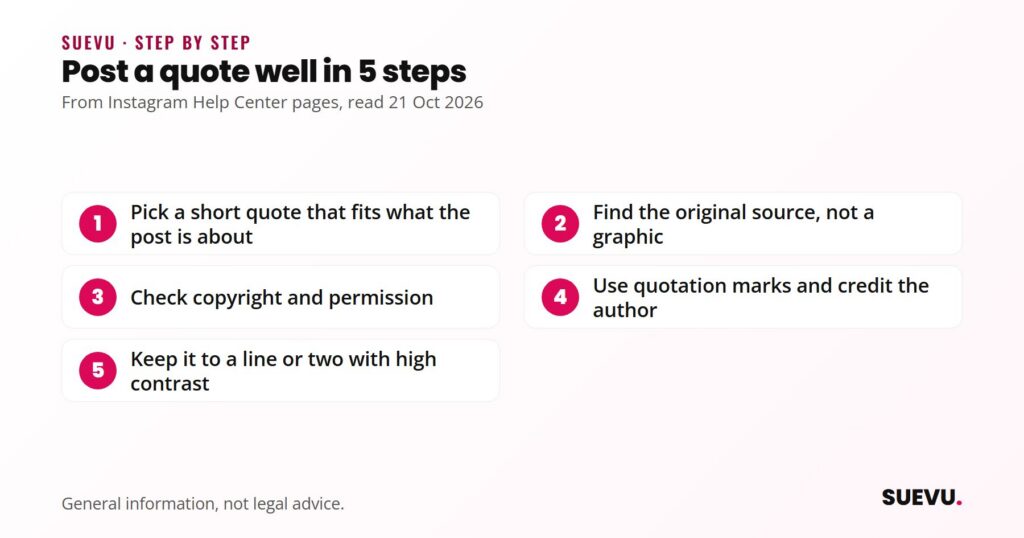
How to choose a quote
- Start with the post, not the quote. Decide what the photo or story is about, then look for a line that adds something rather than repeating the picture.
- Prefer short. A single sentence is easier to read on a phone screen and easier to credit.
- Match the tone. A line that is playful in its original context can sound off against a serious photo.
- Know the context. Read the sentences around the quote. Lines often mean something different from how they are shared.
- Skip anything you cannot trace. If you cannot find the original source, do not use it.
If you want help with the rest of the caption, see our guide to writing Instagram captions.
How to check who said it
Quotes are frequently credited to the wrong person. Wikipedia’s article on false attribution defines it as crediting a work to the wrong person, and says a quotation is often attributed to someone more famous than the real author. That makes a name under a graphic a weak guide to who really said something.
- Find the original. Look for the book, speech, interview or article it came from, and the page or date.
- Be wary of graphics. A quote on an image from another account is not a source. Accounts copy each other, including mistakes.
- Be wary of “unknown” and famous-name quotes. If a line is attributed only to a very famous person, with no work named, treat it as unconfirmed.
- If you cannot verify it, say so (“often attributed to”) or leave it out.
Copyright and permission
Instagram’s Help Center page on making sure content you post does not violate copyright law says you can only post content that does not violate someone else’s intellectual property rights, and that the best way to ensure this is to post only content you created yourself. It says you can infringe copyright even if you included a disclaimer or bought or downloaded the content. It suggests getting written permission from the author, and says you may also be able to use content that is in the public domain, covered by fair use, or subject to another exception.
For quotes, three points from Instagram’s pages are relevant:
- Short phrases. Instagram’s page on what copyright protects says names, titles, slogans or short phrases generally are not considered original enough for copyright protection. It also says copyright protects the original words that express an idea, not the idea or fact itself. That does not mean any quote is free to use: a longer passage, a lyric or a line from a recent book can be protected.
- Fair use is not a free pass. Instagram’s page on fair use and other exceptions says it is often difficult to know whether a use is fair, and lists factors such as whether the use is commercial, how much is used and whether it harms the original’s market. It suggests legal advice if you are unsure. Exceptions also differ by country.
- Credit does not equal permission. Instagram’s guidance lists a disclaimer as something that does not by itself prevent infringement. Crediting someone is good practice, but it does not replace permission when permission is needed.
This is general information, not legal advice. If the quote matters to a business or a campaign, ask the rights holder or a lawyer. Public domain status depends on the work and the country, so check it for your own case before relying on it.
How to credit a quote
- Put the quotation in quotation marks in the caption, so it is clear which words are not yours.
- Add the author’s name on the next line or after the quote, with the work if you know it.
- If you are sharing someone’s post, use Instagram’s own sharing. Per Instagram’s Help Center page on sharing someone’s post to your story, you can only share a feed post to your story if their account is public and they have allowed resharing, and anyone who views it can see who originally posted it.
- Tag the account if the quote comes from a creator’s own post and you have their permission to repost it.
- Do not remove a watermark or name from someone’s image to post it as your own.
If you run a business account and use quotes in your marketing, our guide to turning followers into customers covers the next steps.
How to format it on Instagram
In a caption
- Open with the quote, then add one or two sentences of your own saying why it fits. For tags to go with it, read our guide to finding trending hashtags.
- Use line breaks so the credit is separate from the text.
- Add alt text if the quote is on an image. Instagram’s Help Center says automatic descriptions are generated by object recognition and that you can replace them with a better one.
In a story
Instagram’s Help Center page on editing your story lists the text tools. After you add text you can change its size with the slider, center or align it left or right (for some styles), rotate and resize it with two fingers, choose a colour, change the text style with the button at the top and add a colour background. You can also start from a text-only story by swiping to the type option, so no photo is needed.
- Keep it to a line or two. Long quotes are hard to read before a story moves on.
- Use high contrast between text and background.
- Credit the author in the same story, near the quote.
On an image or carousel
- Use plain, legible type and enough empty space around the words.
- Put the credit on the image, not only in the caption.
- For several quotes or a short series, use a carousel: see our guide to the Instagram slideshow and carousel, or build layouts with template tools.
Writing your own line
The safest quote is one you wrote. Use a sentence that sums up the post in your own words, say so (“my rule of thumb:”) and put your name on it. You can also turn a customer comment, with their permission, into a short pull quote. For ideas on what to say next to a photo, see how to take photos for Instagram, and browse more Instagram guides.
FAQ
Can I post a famous quote on Instagram?
Often yes for a short, well-known line, but there is no blanket rule. Instagram says short phrases generally are not original enough to be protected, but longer passages, song lyrics and recent works can be. Check the source and use your own judgement.
Do I need to credit the author?
Crediting is good practice and helps readers find the original. Instagram’s pages say a disclaimer does not by itself make a use legal, so credit does not replace permission when permission is required.
Why do the same quotes appear with different names?
Misattribution is common. Wikipedia says a quotation is often attributed to someone more famous than the real author.
Can I use quotes to get more followers?
We found no Instagram source saying quotes boost reach or follower counts. Instagram says only that you should post content you have rights to. A quote that fits your content and audience is a reasonable choice, but treat any promise of likes with caution.
Can I repost someone else’s quote graphic?
Use Instagram’s own share feature where it is available, and ask permission for anything else. The share option only works for public accounts that allow resharing.
Are quotes from old books free to use?
Not automatically. Copyright eventually ends, but when depends on the work and the country, and translations or recent editions can have their own rights. Check before posting.
Rules and menus change often. If something here is out of date, tell us via the contact page, as described in our editorial policy.