
 Alizabeth Swain
How to get sponsors on Instagram comes down to four things: a profile that shows who you reach, proof of your audience, a short and honest pitch to brands that fit, and clear disclosure once a deal starts. This guide walks through each step in order.
It is written for creators and small accounts that want paid or product-based partnerships. If you are the brand, read our guide to Instagram influencer marketing instead. We do desk research only: the rules come from pages we opened on 21 October 2026, and the outreach advice is editorial. We found no reliable source for typical sponsorship rates, so this guide does not quote any, and the 2019 article’s average-price claim has been removed.
Quick answer: make your contact details easy to find, put your real audience numbers into a one-page media kit, pitch brands you genuinely use with a specific idea, agree the terms in writing, and label every sponsored post clearly. No platform number guarantees a deal.
Status: current as of 21 October 2026. Cost: free. Risk: undisclosed sponsorships can breach US FTC rules, and fake followers can damage trust with brands.
What a sponsorship is
A sponsorship is an arrangement where a brand gives you something of value, such as money, free products or a commission, and you feature the brand in your content. The FTC’s Disclosures 101 for social media influencers treats free or discounted products as a connection that must be disclosed, even if you were not asked to mention the product. So a gifted item counts as a sponsorship for disclosure purposes, even when no money changes hands.
Before you pitch, make sure the basics are in place. If you are still building an audience, start with our guide on how to be an Instagram influencer, and see Instagram influencers for the size tiers brands talk about.
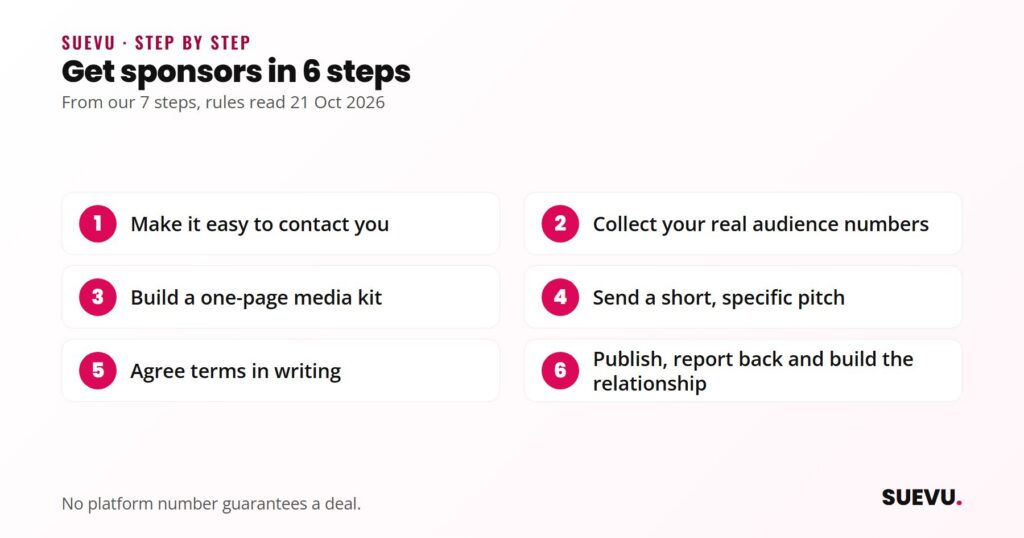
The 7 steps
1. Make it easy to contact you
- Add a business email to your bio or contact button. Use an address you can share publicly rather than your personal one.
- Keep your link useful: one link that leads to your media kit, website or a link page. See our link in bio guide and the Linktree review.
- Use a clear bio that states your niche. Our bio ideas can help.
- Check your direct messages for brand requests; see our guide to managing your Instagram inbox.
2. Collect your real numbers
Brands want evidence that your audience is real and fits them. According to Wikipedia’s Instagram article, Insights shows reach, impressions, engagement and demographic data. Record your follower count, average reach, top countries, age ranges and your best-performing posts. Use screenshots from your own account and the date you took them. Do not round up or invent figures; a brand can ask for screenshots.
3. Build a one-page media kit
A media kit is a short document that tells a brand who you are. A useful one includes:
- A photo and two sentences about you and your niche.
- Your handle, link and contact email.
- Your audience data from step 2, with the date.
- Two or three of your own posts that show your style.
- What you offer, for example one feed post, a Reel or a set of Stories.
- Past collaborations only if you have them. If you have none, leave the section out.
This is our editorial checklist, not an official format. Keep it to one page, and refresh the numbers every month or two.
4. Make a shortlist of brands that fit
Start with brands you already buy and could speak about honestly, since the FTC page says not to describe experiences with products you have not tried. Look at who your followers already tag, and which brands work with creators in your niche. Several platforms connect creators and brands; compare them in our influencer platforms section. To see how brands search, read how brands find Instagram influencers. Keep the shortlist small enough that you can personalise every message.
5. Send a short, specific pitch
Look on the brand’s website or social profiles for how it handles collaborations, and follow that route. Keep the message short, lead with what you would do for them, and attach your media kit. A template follows in the next section.
6. Agree terms in writing
Before you post anything, get the details written down, even if it is only an email thread:
- What you will deliver, in what format, and by which date.
- What you will receive: payment, product or commission, and when it arrives.
- How the post will be labelled (see the FTC rules below).
- Whether the brand can reuse your content, and for how long.
- Who approves the content before it goes live.
For larger deals, consider getting legal advice. We cannot give legal or tax advice, and income from sponsorships may be taxable where you live; check with your local tax authority.
7. Publish, report back and build the relationship
After the post goes live, send the brand your Insights for that post with the date. A short, honest report makes it easier for them to work with you again. Repeat partnerships tend to be easier to land than cold pitches, but we do not have a source for how often that happens.
A pitch template
The text below is a template with placeholders, not a real example. Replace every bracket with true information.
Subject: Collaboration idea from [your name], [niche] creator
Hi [name],
I am [your name], and I post about [niche] on Instagram at [handle]. I have used [product] for [honest detail, for example “the last few months”] and my followers often ask about [topic].
I would like to suggest [one specific idea, such as a Reel showing how you use it]. My audience is mainly [country and age range from Insights, with date]. My media kit is attached.
If this is of interest, I would be glad to talk about timing and terms.
Thanks,
[name]
Two cautions. Do not send the same message to fifty brands, and do not claim experience with a product you have not used. If you have never used it, say you are interested in trying it and ask what they would suggest.
What to charge
We cannot give you a number. We did not find an authoritative, current source for typical Instagram sponsorship rates, and numbers published by marketing blogs vary and often cannot be checked. Practical ways to set a fee:
- Work out the hours you spend on planning, shooting, editing and posting, and set an hourly value you are happy with.
- Consider your audience size, engagement and how closely your followers match the brand.
- Include any usage rights the brand wants. More usage generally justifies a higher fee.
- Ask the brand for its budget first if they contact you.
- For product-only deals, decide in advance what value of product is worth the work. If you accept free product, the FTC rules on disclosure still apply.
FTC disclosure rules
The FTC’s Disclosures 101 for social media influencers, read on 21 October 2026, says:
- Disclose any financial, employment, personal or family relationship with a brand. Free or discounted products count.
- Place the disclosure with the endorsement itself, not only in a bio, at the end of a post, behind a “more” link or among hashtags.
- Use simple words such as “ad”, “advertisement” or “sponsored”. Avoid “sp”, “spon”, “collab” or a stand-alone “thanks” or “ambassador”.
- For photos and Stories, put the disclosure on the image and leave time to read it. For video, put it in the video. For live streams, repeat it.
- Do not talk about products you have not tried, and do not say a product is great if you thought it was bad.
- Do not assume a platform’s disclosure tool is good enough on its own; use your own clear disclosure as well.
The FTC’s Endorsement Guides questions and answers says these rules apply regardless of how many followers you have, and that brands and agencies are expected to train and monitor the influencers they work with. If a brand gives you no guidance on disclosure, ask for it and write the wording into the agreement. Outside the United States, check your own regulator’s rules.
Mistakes to avoid
- Buying followers to look bigger. It can break Instagram’s rules, and brands can often spot fake audiences. For commercial use, the FTC’s reviews and testimonials rule Q&A covers knowingly buying fake indicators of influence. See our comparison of free follower offers for what those services ask for.
- Using tools that need your password or automate actions. They can lead to restrictions on your account.
- Promising results you cannot control, such as sales figures.
- Hiding the sponsorship. This is the one most likely to cause a legal problem.
- Accepting everything. A deal that does not fit your niche can cost you follower trust.
For more advice on growing an account first, browse our Instagram guides or the nine ways in how to build an Instagram following.
Also useful: cute Instagram bio ideas.
FAQ
How many followers do I need to get sponsors?
There is no minimum that applies everywhere. Brands choose based on fit, engagement and audience, and the FTC sets no follower threshold for its rules.
Do I have to disclose if I only got a free product?
Yes, according to the FTC’s Disclosures 101 page. Free or discounted products count as a connection to disclose.
Should I wait for brands to contact me?
You can do both. Make your contact details visible so brands can find you, and pitch a short list of brands that suit your niche.
Do I need a media kit?
It is not required, but a one-page summary of your audience data saves time and makes your pitch look prepared.
Can I work with several brands in the same category?
That is a matter for your agreements. Some brands ask for exclusivity, so check this before you sign.
Is a sponsored post different from an affiliate link?
Both need disclosure. An affiliate link means you earn a commission on sales, which is a financial relationship the FTC says must be disclosed.
Further reading
- FTC: Disclosures 101 for social media influencers
- FTC: Endorsement Guides, what people are asking
- FTC: Consumer reviews and testimonials rule, questions and answers
- Wikipedia: Instagram
Last reviewed 21 October 2026.